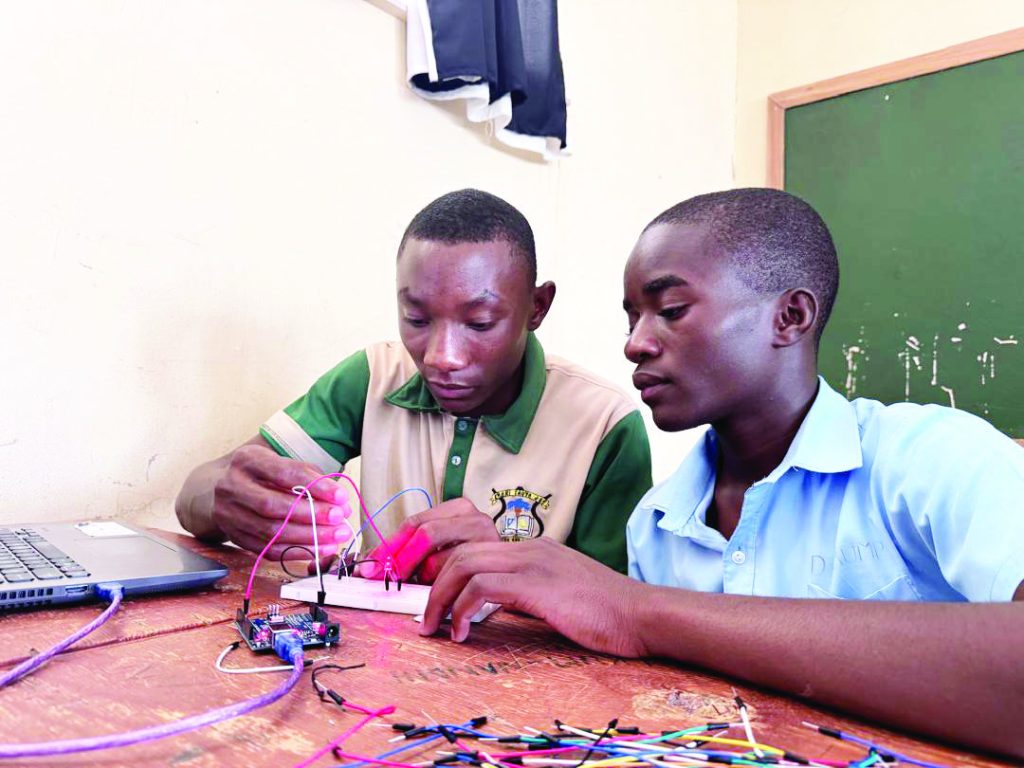
…says Namibia must move beyond training learners and help turn their inventions into viable businesses and solutions.
By Koviao Matuzee
Mindsinaction chief executive officer (CEO) Ndaudika Mulundileni has called for greater investment in young innovators, saying Namibia must do more to help learners turn their ideas into practical solutions, businesses and future employment opportunities.
Mulundileni said while science, technology, engineering, arts and mathematics (STEAM) education equips young people with essential skills, promising inventions risk remaining classroom projects without sustained funding, mentorship and access to technical resources.
Mindsinaction is a Namibian education organisation established in 2018 that provides hands-on STEAM learning through robotics, coding, electronics, 3D printing and other technology-based activities, encouraging learners to become creators and problem-solvers rather than simply consumers of technology.
“Do not fund only the day a learner presents an idea; help fund the work required to make it useful to society,” Mulundileni said.
The organisation has reached more than 7,000 learners and trained over 200 teachers through its programmes and partnerships, exposing young people to practical technology education, including in underserved communities.
Through partnerships with organisations such as the Bank of Namibia, Debmarine Namibia, ExxonMobil and the Namibia Scientific Society, Mindsinaction has taken equipment and facilitators to schools where access to computers and laboratories remains limited.
Mulundileni said the need for such interventions was evident during the Bank of Namibia partnership, where some schools had computer rooms without functioning computers.
In the 2025 cohort of 240 learners under the partnership, 60% reportedly had no previous computer exposure, while 90% had never heard of STEAM.
Following the bootcamp, all participants could define the concept, with learners also demonstrating coding and circuitry skills.
Beyond technical knowledge, Mulundileni said the programmes encourage young people to identify problems in their communities and develop solutions using science and engineering.
These include prototypes addressing wildfires, water monitoring, human-elephant conflict, and road accidents involving livestock.
Namibian learners have also demonstrated their potential on international platforms. Scholar Sprouts from Delta Secondary School won the continental finals of the STEM Africa programme in Cape Town in 2025 with an aquaponics system designed to use fish wastewater to support crop production.
In 2026, Aqua Volt from Hage G. Geingob High School won the national competition pathway before placing fourth at the regional finals with a floodwater-harvesting and purification solution.
However, Mulundileni acknowledged that competition success does not automatically translate into sustainable businesses or employment.
While selected learners receive mentorship, technical guidance, electronics kits and further-training opportunities, he said the organisation does not yet have a sustained incubation system capable of taking every promising project from prototype to market.
Mindsinaction has identified the need for an innovation-support mechanism that could provide prototype grants, specialist mentors, testing facilities and links to universities and industry.
The organisation also recognises the need to strengthen its tracking of former participants.
Although it reports that some alumni have progressed to university and it provides approximately 10 internship opportunities annually, it does not yet have a verified graduate employment or business-formation rate.
Mulundileni said STEAM education alone could not resolve Namibia’s youth unemployment crisis, but early exposure to practical skills could help young people prepare for changing industries and create opportunities of their own.
He called for stronger collaboration between government, schools, employers, universities and private-sector partners to expand access to technology education and support promising innovations beyond the classroom.
His vision is for opportunities to become an innovator to depend less on where a child lives or whether their school is well-equipped, with practical problem-solving becoming a more regular part of education across Namibia.