


By Rinelda Mouton & Sostenus Wilherm
The Anti-Corruption Commission (ACC) is once again facing allegations that some of its investigations are being driven by personal vendettas, workplace disputes and private grievances rather than genuine corruption-related complaints.
Over the years, several individuals investigated or arrested by the ACC have publicly claimed they were targeted following fallout with former colleagues, business associates or individuals with influence in institutions and companies.
In some cases, matters investigated by the ACC were later withdrawn, struck from the court roll or found to involve disputes of a civil or contractual nature. However, according to some of those cleared of wrongdoing, the damage caused by highly publicised arrests and court appearances is irreparable, as their reputations remain permanently tainted.
The latest matter drawing attention involves a case currently before the courts relating to an alleged N$320,000 vehicle transaction involving a Jeep Grand Cherokee and former senior Namibian Airports Company (NAC) employee Boas Naanda in 2014. He was, however, arrested earlier this year over the matter.
Court documents seen by Confidente reportedly reveal contradictions and discrepancies in affidavits and witness statements relating to the payment arrangement for the vehicle.
The accused maintains that the vehicle had already been fully paid for before his departure from the NAC and claims documentary proof exists to support this assertion.
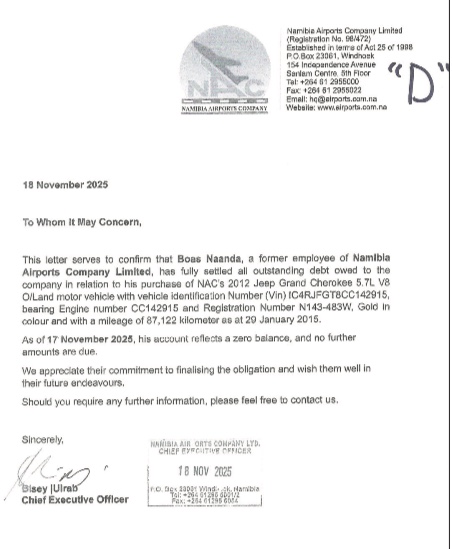
This was corroborated in a letter dated 18 November 2025 by NAC chief executive officer Bisey |Uirab, in which he exonerates Naanda, stating: “[He] has fully settled all outstanding debt owed to the company in relation to his purchase of NAC’s 2012 Jeep Grand Cherokee 5.7L V8… As of 17 November 2025, his account reflects a zero balance and no further amounts are due.”
Meanwhile, according to court papers, the matter allegedly revolves around a bounced cheque and a disputed sale agreement relating to the vehicle transaction.
Questions have since emerged over whether the dispute constituted criminal fraud or whether it was essentially a civil contractual disagreement between the parties.
Naanda further alleges that the complaint was motivated by personal grievances linked to former associates and colleagues.
In a sworn affidavit, Naanda maintains that he acquired the vehicle after being “the sole bidder in a closed bid process” held on 20 March 2015, with an initial bid of “N$120,000.”
According to him, NAC officials later argued that the bid was below market value and, following discussions with senior officials, including then acting CEO Tamer El-Kallawi, Naanda agreed to renegotiate the price because he was concerned about the vehicle’s poor condition.
He states: “My most immediate concern was the condition of the vehicle, as the vehicle was not in a road-worthy condition.” He claims the agreement was revised to N$320,000 on condition that NAC first carry out bodywork and mechanical repairs.
However, Naanda alleges that NAC failed to fully honour the agreement, saying mechanical defects remained unresolved and that spare parts had to be imported from the United States. He describes this as “a material breach of our agreement.”
The affidavit further states that Naanda later stopped payment on a cheque of N$320,000 after allegedly realising NAC was “reneging on their promise.” He also disputes attempts to deduct money from his salary, claiming the proposed deductions violated the Labour Act.
The documents further reveal that Naanda rejected signing an admission of liability, stating: “I sternly reject the demand that I sign the admission of liability.” He further alleges that he raised concerns with the Ombudsman and NAC management regarding suspected corrupt activities within the company.
CONDUCT
The matter has also attracted attention following allegations that details surrounding the arrest were circulated on a private WhatsApp platform by Timothy Utale, a senior ACC investigating officer, raising concerns over professionalism and confidentiality within the anti-graft body.
Naanda claims the arrest and publicity surrounding the matter caused reputational damage, financial losses and the retrenchment of employees linked to his business operations.
When approached for comment, Utale denied knowing Naanda but is aware of the matter.
“I have never posted Naanda on why Whatsapp status. Why would I do such a thing? What do I have to gain from doing that? I know who is behind this, spread- ing these lies. This is not true. This is false. Do not try to dirtify my name. I am busy consulting my lawyers on the matter. Whowever, os spreading this must have their evidence,” Naanda said.
HISTORY
In recent years, the ACC has repeatedly found itself drawn into matters that later became controversial or politically charged. Former officials and executives from several public institutions have similarly accused the ACC of moving aggressively against suspects before fully establishing whether disputes were criminal in nature or administrative and civil in character.
Legal experts have previously warned that criminal investigative bodies must exercise caution when handling matters involving contractual disagreements, debt disputes or failed business arrangements to avoid criminalising civil disputes.
The ACC, however, has consistently defended its operations, maintaining that it acts on complaints brought before it and investigates matters where there is reasonable suspicion of corruption, fraud or related offences. The Commission has also repeatedly denied claims that it acts on behalf of political or personal interests.
Under the Anti-Corruption Act, the ACC is mandated to investigate corruption-related offences in both the public and private sectors, including bribery, abuse of office, fraud linked to public institutions and other economic crimes.
Despite this mandate, questions continue to arise regarding the extent to which certain fraud-related matters fall within the ACC’s jurisdiction, particularly where disputes originate from private agreements between individuals.
RESPONSE
ACC director general Paul Noa referred queries on the matter to his deputy, Erna van der Merwe, confirmed that Utale was the investigating officer in the matter. She added that Utale has however resigned from the commission. According to her the matter is now before the courts following a de- cision by the prosecutior general and any questions on the issuer should be channled to that office.