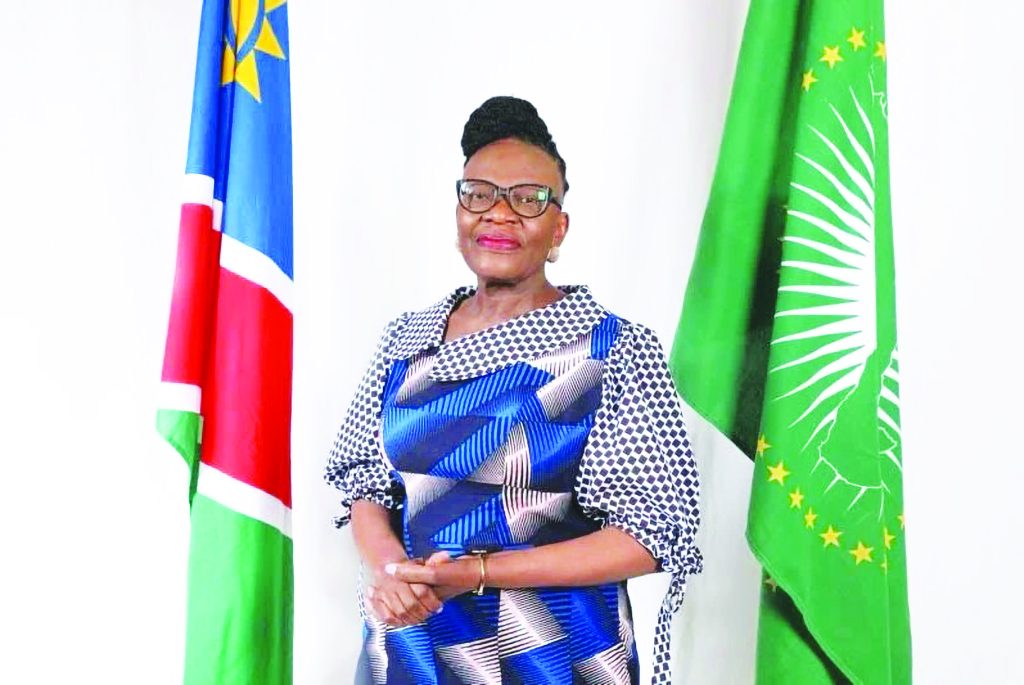



By Stefanus Nashama
International relations and trade Selma Ashipala-Musavyi said measures directed at the International Criminal Court (ICC) judges and other officials by the United States raise legitimate concerns.
Measures are in connection with the discharge of their judicial or prosecutorial functions regarding judicial independence and the ability of the court to carry out its mandate without external pressure.
“Namibia has noted with concern the designation, on 18 August 2026, of Judge Tomoko Akane of Japan, President of the ICC, and Mr Abdoulaye Seye of Senegal, Senior Trial Lawyer in the Office of the Prosecutor. Namibia’s position on this matter is one of principle and should not be construed as taking the side of one State against another,” said Ashipala-Musavyi.
The minister also expressed that Namibia is a state party to the Rome Statute and attaches particular importance to the independence of international judicial institutions.
“Namibia’s commitment to international law is deeply rooted in our own history. International law and the United Nations played an indispensable role in Namibia’s path to independence, and our constitution accordingly places particular emphasis on respect for international law and treaty obligations.”
According to her, Namibia recognises that the United States is not a party to the Rome Statute and has longstanding concerns regarding the exercise of the court’s jurisdiction over nationals of non-states parties.
“Namibia’s view, however, is that differences concerning the jurisdiction or conduct of the court are best addressed through established legal and diplomatic channels,” she said.
Ashipala-Musavyi indicated that it is not for Namibia to prescribe how the United States should conduct its foreign policy.
Namibia can, however, state its own position, which is that measures directed against individual judicial officials are neither necessary nor conducive to safeguarding the independence of international justice, she added.
“The Rome Statute provides mechanisms through which questions concerning jurisdiction, admissibility and the exercise of the court’s mandate may be addressed. States also have diplomatic and multilateral avenues through which concerns regarding the Court may be raised,” she said.
“This does not mean that Namibia considers the ICC to be beyond criticism,” she said.
At the same time, Ashipala-Musavyi emphasised that Namibia recognises longstanding concerns, including those expressed by African states, regarding consistency, even-handedness and accountability in the work of the court.
Such concerns, the minister said, are legitimate and should continue to be addressed through the Assembly of States Parties and other appropriate mechanisms.
“Strengthening the court and safeguarding its independence are not mutually exclusive objectives,” she said.
Concerning sanctions, Ashipala-Musavyi said Namibia is not the subject of these designations, and it does not expect this difference of view to adversely affect its bilateral relations with the United States.
Namibia values its longstanding and constructive relationship with the United States across a broad range of areas of mutual interest, she said.
The minister also stressed that the broader implications are nevertheless of concern to Namibia and other states parties.
“Measures that affect the ability of judges, prosecutors or other officials to perform their functions may, over time, affect the effective functioning and independence of an institution established by treaty.”
“For Namibia, and indeed for small states generally, a rules-based international order remains an important safeguard. Our interests are best served by an international system in which agreed rules are applied consistently and disputes are resolved through law, dialogue and established multilateral mechanisms.
She indicated that Namibia remains a state party to the Rome Statute and will continue to discharge its international obligations in good faith, adding that Namibia will continue to engage constructively on matters relating to the court and the broader international justice system.
The US recently announced sanctions against ICC officials over their involvement in proceedings concerning officials whose governments have not accepted the court’s jurisdiction.
The sanctions include asset freezes, travel restrictions and limits on services that can be provided by US companies.
The ICC, established in 2002, is an independent international court, empowered by more than 120 member countries and mandated to investigate and prosecute individuals accused of genocide, crimes against humanity and war crimes under conditions set out in the Rome Statute.
The United States is not a member of the ICC and has consistently rejected the court’s jurisdiction over American nationals.
In response, the ICC has strongly condemned the sanctions, describing them as an attack on an independent judicial institution.
The court has maintained that measures targeting its judges, prosecutors and staff undermine the rule of law and threaten the international legal order.
“The ICC remains undeterred and stands firmly behind its personnel,” the court said.