


By Rinelda Mouton
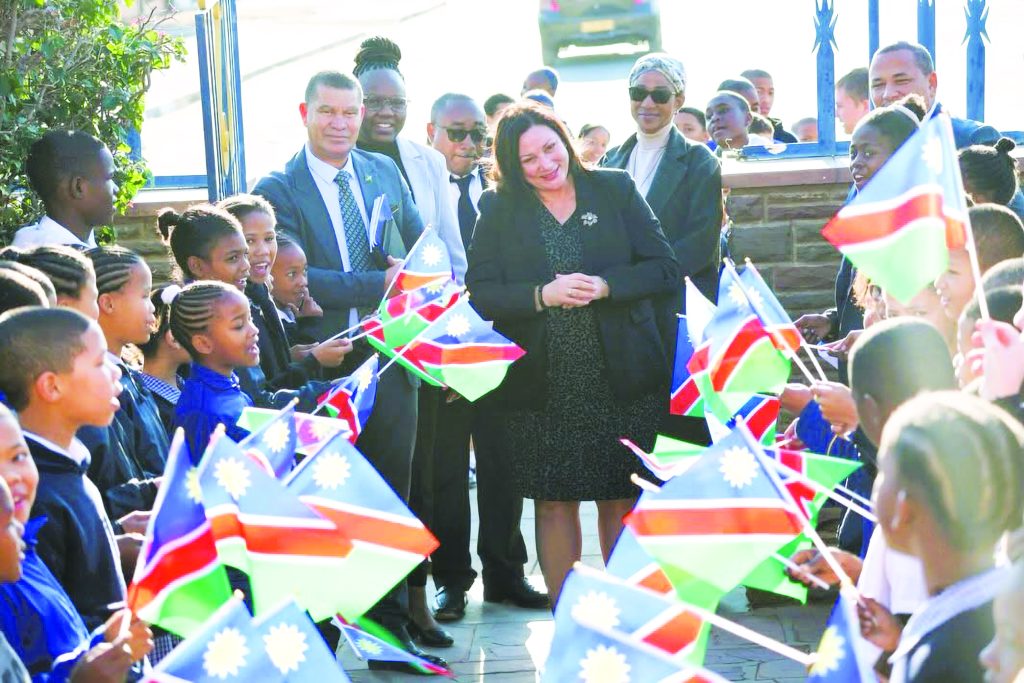
Dreams can come true is the statement Minister of Education, Innovation, Youth, Sport, Arts and Culture Steenkamp believes in. Confidente recently spoked to Steenkamp as she shares more insight about her life growing up, her role as a Minter and hopes for the future.
Q: Tell us more about your life growing up?
A: I grew up in a family and environment that taught me the importance of values, discipline, hard work and caring for others. My mom was a single mother. From a young age, I was taught that whatever you do in life, you should do it to the best of your ability and with respect for other people. A very special memory was from 1986, when the library in the town of Karasburg, that had previously been reserved for Whites only was finally opened to all of us. I remember walking what felt like a very long distance into town because I was so eager to have access to those books. I could travel to different countries, learn about different cultures and people, discover places I had never seen and imagine possibilities far beyond my own surroundings.
Q; Being a little girl, did you picture yourself as a Minister one day?
A: Absolutely not! As a little girl, becoming a Minister was certainly not something I imagined. My ambitions were much more ordinary and centred around doing well at school and becoming an actress or a teacher. Life has a wonderful way of taking us places we never anticipated. My journey into education, leadership and eventually public service developed step by step. I did not set out with the destination of becoming a Minister; rather, I tried to do every job entrusted to me with commitment and integrity. I spent 18 years of my professional career in the North and it shaped me in the most profound ways.
Q: What advice do you have for other women?
A: Believe in yourself and never stop learning. Don’t be afraid of their own potential. There will be moments when people doubt you. Sometimes you may even doubt yourself. Don’t feel that you have to become someone’s worth. Be your own true authentic self. Your own voice, your own experience and your own perspective are valuable.
Q: Being where you are today has not been easy. How did you do it?
A: It has been a long journey and not a straight line. I think three things have carried me through: faith, perseverance and a willingness to learn. I have had people who believed in me, mentors who guided me, colleagues who supported me and family who stood beside me. I have also made mistakes and experienced disappointments. Those experiences have taught me as much as the successes have.
Q: What do you like doing that most people do not know?
A: I love trees. I actually hug them. There is something very grounding about being close to a tree. It reminds me to slow down and appreciate nature, its splendour, its beauty and its quiet strength. Hugging trees is one of my little joys. It keeps me grounded and makes me appreciate the extraordinary beauty of the natural world.
Q: What are your hobbies?
A: I enjoy reading, music, culture and spending time in nature. I also appreciate quiet moments when I can simply think and reflect. I have always had a strong appreciation for the arts, which I believe began very early in my life through music and the visual arts. When I travel for work, I always make sure to fit in time to either visit some cathedrals or museums or simply sit in a park. I also love gardening.
Q: How do you spend your time off?
A: When I have time away from official responsibilities, I value being able to slow down. I enjoy spending time with family and friends, reading, listening to music and simply being at home without a schedule. After a very demanding week, sometimes the greatest luxury is having nowhere that I have to be. I also value time outdoors and being in nature. It helps me to step away from the demands of public life and regain perspective.
Q: Tell us about your life at home?
A: At home, I am simply Sanet. The Minister stays at the office. I value family, warmth, conversation and the little routines that make a home feel like home. I also appreciate having a space where I can take off the public responsibilities for a while and simply be myself.
Q: From your life experiences so far, what is one moment that you still remember?
A: There is one childhood memory that has remained especially vivid for me: walking with my late mother, Maria, to the Catholic Church for early morning Holy Mass. We would arrive very early and wait together at the small gate for the priest to come and open it for us. I remember those quiet mornings, walking beside my mother and waiting at the gate. They remain very precious memories. I Loved the singing in the church. I think those early experiences planted the first seeds of my love for music
and the arts.
Q: How do you spend your time when you arrive home from work?
A: Usually, the first thing I want is to change out of my work clothes and have a moment to breathe. I like to decompress, have something to eat, talk to family and catch up on what happened during the day. I also value a little quiet time. I try to create some separation between the public role and home.
Q: Besides your high professional position, what type of person would you say you are?
A: I would describe myself as warm, approachable, curious and very grounded. I enjoy people and I enjoy learning from people, regardless of their position in society. I also have a strong sense of humour and appreciate good conversation. I am a person who cares deeply about people, education, our country and about doing things properly.
Q: Being a Minister, what are some of the challenges that you face?
A: One of the greatest challenges is that the expectations are enormous, while resources and time are not unlimited. Education affects every family, so there are understandably many expectations of what government should deliver. Another challenge is making difficult decisions while ensuring that those decisions are fair, evidence-based and in the best interests of our children. For me, the responsibility is ultimately about remembering that behind every statistic is a child whose future matters.
Q: In your view, how can Namibians help to make your job better?
A: I believe government cannot transform education alone. Parents, teachers, learners, traditional leaders, communities, business, civil society and development partners all have a role to play. Encourage children to read. Make sure they attend school. Support teachers. Protect schools. Create an environment where education is valued. Where people disagree with government, I would encourage constructive engagement. Criticism is important, but criticism accompanied by ideas, responsibility and partnership is even more powerful.
Q: What does your position mean to you?
A: It is a tremendous honour, but above all, it is a huge responsibility. Being a Minister means having the privilege of contributing to decisions that can affect the lives of many people, particularly our children and young people. I never forget that education is about much more than examinations and certificates. It is about giving a child the foundation to discover who they are, what they can become and how they can contribute to society. That is why my personal motto in this portfolio is: Foundation First, Excellence Always.
Q: Anything new that the public can expect to change in education soon?
A: Yes. We are continuing to place much greater emphasis on the foundations of learning, particularly literacy, numeracy and early childhood development. We are also strengthening teacher support and training, expanding the use of technology in education and working to make our education system more inclusive and responsive to the needs of every learner. The reason this is important is very simple: if we get the foundation right, we give children a much stronger chance of succeeding later in their education and in life. We cannot wait until a learner reaches secondary school before we address gaps that began in the early years. That is why our approach is not simply about changing policies; it is about changing outcomes for children.