By Koviao Matuzee
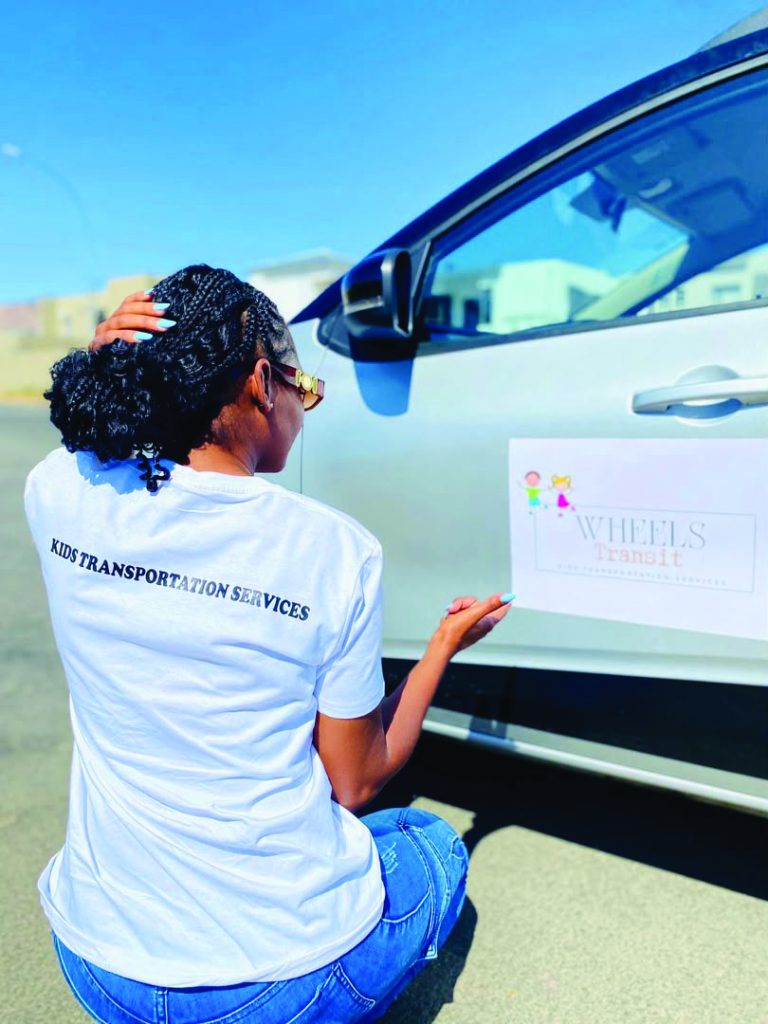
According to Kavejaruka Kozonguizi, entrepreneurship is about more than running a business; it is about solving problems and creating opportunities. Through Wheels Transit, she is building a future driven by innovation, resilience, and a vision that extends beyond herself.
Q: Can you tell us a little bit about yourself?
A: My name is Kavejaruka Kozonguizi, and I am a Namibian entrepreneur and the founder of Wheels Transit, a children’s transportation business based in Windhoek. I am passionate about solving real-life problems, building sustainable businesses, and creating opportunities that make a meaningful difference in people’s lives. My journey has taught me the importance of resilience, taking calculated risks, and having the courage to pursue an idea even when the outcome is uncertain.
Q: What inspired you to start Wheels Transit, and how did you turn that idea into a business?
A: Wheels Transit was born out of a transportation challenge I had experienced firsthand. I understood how difficult it could be to find reliable transportation, particularly when it comes to children and the peace of mind that parents need when entrusting someone with their little ones. I saw an opportunity to provide a service that goes beyond simply getting children from one place to another. I wanted to build a service centered on safety, reliability, accountability, and trust. I took that idea and began turning it into a business, putting systems in place, investing in vehicles, and building relationships with parents. Today, Wheels Transit provides school transportation and related transport services in Windhoek. We use GPS tracking and live in-car cameras to strengthen accountability and give parents greater peace of mind. What started as an idea has become a growing business with a bigger vision: to build a trusted transportation brand that families can depend on.
Q: You started this business while still at university. What gave you the courage to take that step before you had everything figured out?
A: I think the courage came from understanding that if I waited until everything was perfect, I might never start. Being a student did not mean I had to put my ideas and ambitions on hold until graduation. I knew there would be challenges, and I certainly did not have all the answers. However, I believed in the problem I wanted to solve and was willing to learn along the way. I approached the business one step at a time, learning about operations, finances, customer relationships, and what it takes to run a business. Balancing entrepreneurship with my studies was not always easy, but it taught me discipline, resilience, and how to manage competing priorities. I have learnt that courage is not necessarily the absence of fear or uncertainty; sometimes, it is choosing to start despite both.
Q: What has been the most difficult challenge you have faced as a woman entrepreneur, and how did you overcome it?
A: One of my biggest challenges has been keeping the business running sustainably while managing the financial and operational demands that come with transportation. Vehicles require constant maintenance, fuel costs money, employees need to be paid, and parents expect a reliable service every day. These responsibilities do not disappear when business is slow, or unexpected challenges arise. As a woman entrepreneur, you also have to learn to trust your own decisions, stand firm in your leadership and navigate situations where people may not fully appreciate the responsibility that comes with running a business. I have worked through these challenges by learning to make difficult decisions, improving my planning, and remaining focused on the long-term vision. I have also learnt that being a good leader does not mean pleasing everyone; it means making decisions that protect the business, its clients and its future. The journey has taught me that resilience is not just about surviving difficult moments. It is about learning from them and becoming a better businesswoman because of them.
Q: Parents entrust you with their children’s safety. How have you built that trust, and what does this responsibility mean to you?
A: For me, trust is built through consistency, communication, and accountability. Parents are not simply paying for transportation; they are entrusting us with people who mean the world to them. I never take that responsibility lightly. At Wheels Transit, we use GPS tracking and live in-car cameras, with access to the monitoring system restricted to authorized individuals. We also prioritize communication with parents through WhatsApp groups, and we encourage introductions between parents and drivers so that families know who is responsible for transporting their children. Wherever possible, we maintain consistent driver assignments to create familiarity and continuity. However, technology alone cannot build trust. It must be supported by responsible drivers, clear communication, professionalism, and a genuine commitment to the children’s well-being. To me, every child represents someone’s greatest responsibility and most precious gift. That understanding shapes the standards I want Wheels Transit to uphold. My goal is for parents to feel confident that their children are being transported with care, responsibility, and respect.
Q: Have you ever felt underestimated because you are a woman in business, and how did you respond?
A: I believe that, as a woman in business, there can be situations where you have to work harder to establish your credibility and demonstrate that you know what you are doing. Entrepreneurship requires you to make decisions, manage people, negotiate, handle finances, and take responsibility when things go wrong. I have learnt not to make proving people wrong my primary motivation. Instead, I focus on building a business that speaks for itself through its service, professionalism, and results. I also believe that leadership is not about being the loudest person in the room. It is about being able to make informed decisions, take responsibility, and remain firm in your values. I want my journey to show other women that they do not have to fit a particular image of what a business owner should look like. We can lead, build, make mistakes, learn, and succeed in our own way.
Q: What have you had to sacrifice personally to keep Wheels Transit running and growing?
A: One of the biggest sacrifices has been my time and personal flexibility. Running a transportation business means that your responsibilities often begin before the day properly starts and continue long after the trips are completed. There are schedules to coordinate, parents to communicate with, operational issues to resolve, and financial commitments to manage. It also means making financial decisions that prioritize the business and its sustainability, sometimes putting personal wants on hold to meet business needs. Balancing entrepreneurship with my academic and professional responsibilities has also required sacrifices. There are times when you have to be intentional about how you spend your time and accept that you cannot do everything at once. However, I see these sacrifices as part of building something meaningful. I am learning to understand that growth requires commitment, but it also requires building systems that allow the business to become sustainable without depending entirely on me.
Q: Was there a moment when you doubted yourself or considered giving up? What made you keep going?
A: There have certainly been challenging moments when the responsibilities of running a business have felt overwhelming. Entrepreneurship can be lonely because, as the owner, you are often the person expected to find solutions, even when you are still trying to figure things out yourself. There are financial pressures, unexpected operational challenges, and moments when progress feels slower than you had hoped. Those experiences can make you question whether the journey is worth it. What keeps me going is remembering why I started and the potential of what Wheels Transit can become. I think about the parents who depend on our service, the children we transport and the opportunity to build something that can create employment and make a meaningful difference. I have also learnt that a difficult season does not necessarily mean you are on the wrong path. Sometimes, it means you need to reassess, make adjustments, and keep moving forward with a clearer understanding of what needs to change.
Q: Beyond being a founder, who is Kavejaruka, and what experiences have shaped the woman you are today?
A: Beyond being a founder, I am someone who is curious, ambitious, and passionate about finding solutions to problems. My background in Computer Science and my studies in Industrial Engineering and Data Science have shaped how I approach challenges. I naturally look for ways to improve systems, understand problems and find practical solutions. I am also someone who believes in growth. I am learning that becoming the woman you aspire to be is a continuous process. You learn through your successes, but some of your most important lessons come from the moments when things do not go according to plan. Balancing education, professional responsibilities and entrepreneurship has taught me the importance of discipline, patience and adaptability. It has also reminded me that you can be ambitious while still being a work in progress. Ultimately, I want to build a life and career that are meaningful beyond personal achievement. I want the things I create to have value for other people, whether through the services we provide, the employment opportunities we create or the example we set for other young women.
Q: Finally, what do you want Wheels Transit to become, and what message would you give young Namibian women who want to build businesses of their own?
A: My vision is for Wheels Transit to become one of Namibia’s largest and most trusted transportation service providers, starting with children’s transportation and expanding into other mobility services as the business grows. I want to build a brand recognized for safety, reliability, professionalism and innovation. Beyond expanding our fleet and serving more families, I want Wheels Transit to create employment opportunities and eventually contribute to initiatives that help children whose families cannot afford reliable transportation. I believe that a business can be commercially sustainable while also making a meaningful social contribution. To young Namibian women who want to start businesses, my message is simple: do not wait until you have everything figured out before you begin. Start with what you have, understand the problem you want to solve and be willing to learn. You will make mistakes, encounter setbacks and sometimes question yourself, but those experiences can teach you lessons that no classroom can fully prepare you for. Also, do not confuse starting small with thinking small. You can begin with limited resources and still have a big vision. Be disciplined with your finances, take your customers seriously, surround yourself with people who challenge you to grow and remain willing to adapt. Most importantly, do not allow the fear of failing or the opinions of others to make your decisions for you. You do not need to have everything figured out to take the first step. Sometimes, the first step is what begins to show you the way.