By Michael Uugwanga
Returning to sport after childbirth can be challenging, requiring a gradual recovery rather than an immediate return to full training and competition.
For FNB Wanderers Women rugby player Gabriella Bassardien, motherhood has not meant putting her sporting ambitions on hold.
The 28-year-old continues to play rugby while breastfeeding her baby, taking her child along whenever she travels for matches.
Balancing motherhood and competitive sport is not always easy, but Bassardien says she is gradually regaining her fitness and confidence after giving birth.
“In the beginning, it was very difficult because my body went through major physical, hormonal and structural changes. I felt like I would not be able to play the way I did before, but I kept training, and it got better with time.
“I am still not where I was, but I am definitely heading in the right direction. My fitness helped my body recover much faster. I usually breastfeed before a game, just to feel a bit lighter,” Bassardien said.
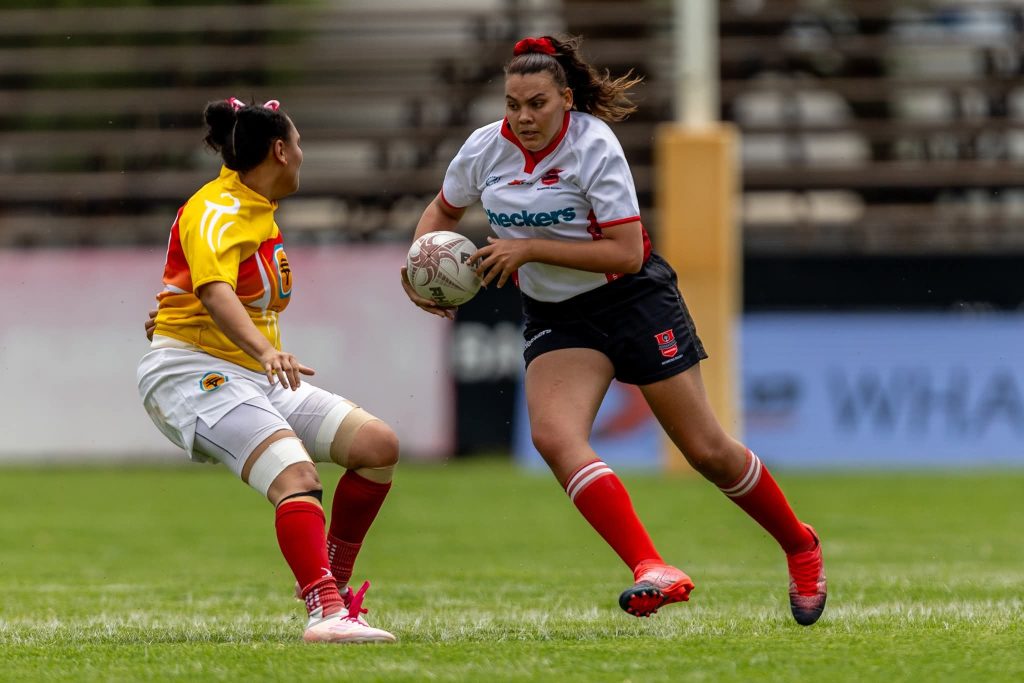
Bassardien, who was in action for Wanderers at the Ongos Sevens tournament at the Hage Geingob Rugby Stadium over the past weekend, says her baby has become a regular presence around the team.
“Yes, my baby travels with me everywhere. I do not think he has missed one game yet. The team gave him a supporters’ shirt, so he is a proud member of the club,” she said.
Born in Windhoek, Bassardien began playing rugby in 2021 in Grootfontein, where she joined Grootfontein Rugby Club. Since then, she has continued to develop her game and establish herself in the sport.
Her introduction to rugby was driven by a desire to play the contact version of the game.
“I wanted to play contact rugby, so I asked the club if we could start a women’s team. They agreed, and that is how my journey in contact rugby started. I joined Wanderers Rugby Club in 2024.
“Playing rugby is my therapy. Rugby is a sport in which one learns about teamwork, discipline and hard work. Playing rugby has shown me that we, as women, are capable of so much more, and we are beating the stereotypes,” she said.
Although her competitive rugby journey began in adulthood, the sport had been part of her life from an early age. Watching her father and brothers play helped develop her interest, while playing touch rugby with them gave her an early understanding of the game.
“Rugby had been part of my life since I was a young girl. I used to watch my dad and brothers play. Later on, I started playing touch rugby with them. But I always wanted to play contact rugby because it looked so much more exciting and structured.
“So, when I got the opportunity to join a club, I already had knowledge of the game and the handling skills. At Grootfontein Rugby Club, I played fly-half, but when I joined Wanderers, I played inside or outside centre.”
While Grootfontein Rugby Club gave her the opportunity to pursue contact rugby, Bassardien believes joining Wanderers took her game to another level.
She now represents the senior women’s national team and the national sevens team, opportunities that have also allowed her to travel to other African countries.
“Joining Wanderers was the best decision I ever made. Playing for them showed me true sisterhood; we stood by each other through it all. If we lost, we would go back to the drawing board and work even harder.
“They stood by me through hard times, and they made me a much better player because the coach has so much knowledge of how to work with you individually, and that builds one’s character and skills,” she said.
Bassardien made her national team debut in 2021 against Zambia. In 2022, she was selected as vice-captain for the team that faced South Africa and Zimbabwe.
That same year, she represented Namibia in a sevens tournament in Lesotho, where the team finished second.
Her journey reflects the gradual growth of women’s rugby in Namibia, although the sport still faces challenges in attracting players compared with more established codes such as football, netball, hockey and cricket.
Bassardien believes women’s rugby is moving in the right direction, particularly with the introduction of T1 rugby, which she says provides opportunities for people of different ages to participate.
“I think women’s rugby is heading in the right direction, as we see more women starting to play, alongside the introduction of T1 rugby, which is for all ages.
“Girl child, you are stronger than you think, and we are capable of anything that we put our minds to. Do not be influenced by negative people; just do what you love,” she said.
She also has an encouraging message for women who want to participate in sports traditionally associated with men, as well as mothers who may be uncertain about returning to physical activity after childbirth.
“If you want to try rugby or any other sport that is usually described as a male sport, just do it. You will only see the power you have once you do it.
“To the ladies who have given birth, do not stay away; it is still possible to play. Your body did something amazing, and with that body, you can still show up and become a superhuman.
“Let us show up and keep inspiring the young. Doing something that you love will help with your recovery, and keeping your mind busy can help with what most women suffer from, postpartum depression.”