



By Feni Hiveluah
A silent national tragedy is unfolding across Namibia as men continue to take their own lives at an alarming rate, exposing a deepening mental health and socio-economic crisis that experts say the country is failing to confront.
Official records obtained from the Namibian Police Force (NamPol) through deputy commissioner reveal that 1,520 Namibians died by suicide between 2023 and 2025.
Of those deaths, a staggering 1,296 victims were men, accounting for more than 85% of all recorded suicide fatalities nationwide.
The figures paint a devastating picture of emotional collapse among Namibian men, particularly in the country’s northern regions, where poverty, unemployment, social pressure and limited access to mental health services continue to fuel despair behind closed doors.
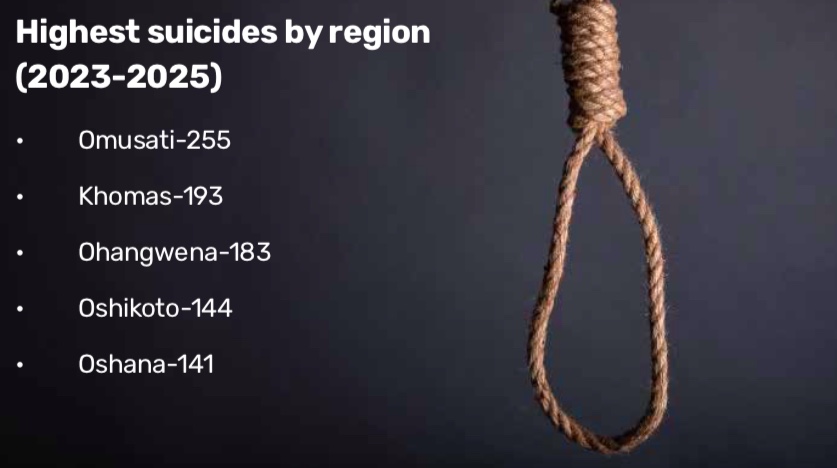
Regionally, the recorded the highest number of suicide cases in the country with 255 deaths between 2023 and 2025. The followed with 193 recorded suicides, while registered 183 fatalities.
Other heavily affected regions include with 144 cases and with 141 deaths.
Together, Omusati, Khomas and Ohangwena account for nearly 42% of all suicide fatalities recorded nationally, raising serious concerns over the distribution of psychosocial support services and mental health interventions in the country’s hardest-hit communities.
The statistics further reveal the methods commonly used. Hanging remains by far the dominant method, accounting for 1,370 deaths nationwide. Firearms were the second most common method, with 92 recorded shooting deaths during the period under review.
Authorities also recorded repeated incidents of people drinking battery water, particularly in northern regions such as Omusati and Oshana.
At least 10 deaths were linked to the ingestion of battery acid. Psychologist said the high suicide rate in northern Namibia is closely linked to structural underdevelopment, limited employment opportunities and deepening social despair.
“There’s very little mental health infrastructure there, chronic poverty, overcrowded households. So there’s really this hopelessness and this emotional climate where people are just in despair and this despair has become normalized,” Whittaker said.
He also pointed to climate stress, alcohol abuse, youth idleness, economic stagnation and social pressure as contributing factors driving the crisis.
Whittaker said the overwhelming number of male suicides can largely be attributed to rigid masculinity norms and economic displacement, which strip many men of their traditional social roles.
“So masculinity in so many ways is emotional imprisonment, because boys are raised with messages like ‘a man must not cry’ and ‘a man must provide’. This leads to emotional suppression, shame about vulnerability and avoiding seeking help,” he explained.
According to Whittaker, many unemployed men migrate to larger towns and cities in search of work but often fail to secure employment, leaving them isolated and emotionally overwhelmed.
“When they cannot provide for their families, they experience what can be described as social humiliation. They collapse internally and don’t know how to cope,” he said.
He further explained that cultural expectations continue to place enormous pressure on men to build homes, support extended families and fulfil financial responsibilities despite worsening economic realities.
Whittaker also highlighted that the use of extreme methods such as drinking battery water is often shaped by accessibility and impulsivity during moments of acute emotional distress.
“In rural northern households, battery water is common because of vehicles, solar systems and household tools. When people are distressed, they use whatever they have access to,” he said. He described such methods as signs of overwhelming emotional dysregulation and silent cries for help.
Addressing youth mental health, Whittaker criticised authoritarian parenting styles common in many households, saying they discourage emotional expression and force children to internalise distress.
“Children don’t feel free to express their emotions. They internalise pain instead of communicating it,” he noted.
Whittaker further warned that Namibia’s mental health system remains severely underresourced despite the growing crisis.
“The nursing staff is completely overstretched. We clearly don’t have enough people in the mental health field. We don’t have enough professionals and the system itself is underfunded. It’s a real disaster,” he said.
The latest statistics now place increasing pressure on public health authorities, policymakers and regional leaders to urgently expand mental health services, particularly in vulnerable rural communities where despair continues to grow in silence.